Invoices and quotations
Make a bill on one screen and print it on A4 or the 80mm roll, or send it as a link. A walk-in sale needs no customer name; the paper says नगद बिक्री.
Accounting · invoicing · inventory
Accounting and invoicing made for shops in Nepal: rupees and paisa, the Bikram Sambat calendar, and VAT and TDS the way the Inland Revenue Department asks for them. Every accounting feature, for every shop, at no cost. Why is it free?
Why free?
Billing, accounting and inventory are the foundation of a shop. We want every shop to have dependable books without paying a subscription just to keep them.
Lamp earns from Purja AI, the optional paid assistant that takes repetitive work off an owner's hands. It sits on top of the free product and is not required to issue a bill, track stock, keep khata or close the year. No advertising, no data sales, and a complete export whenever you ask.
Optional paid assistant · available now
Say what happened in your own words — English, Nepali or romanised Nepali. Purja turns it into a card with the figures filled in and waits for your Confirm. Nothing reaches the books before that.
A question
aaja kati bikri bhayo?
Today's sales are Rs 18,450 across 12 invoices.
Ramesh le kati tirna baki cha?
Ramesh owes Rs 3,200; the oldest of it is 40 days old.
A sale, corrected in words
Sita lai 2 topi 900 each
Nothing is recorded until you press Confirm.
Issued as INV-083/84-00042.
3 topi ho
Two things in one message
300 ko chiya and Hari bought a topi
Nothing is recorded until you press Confirm.
Recorded.
Nothing is recorded until you press Confirm.
Issued as INV-083/84-00043. Price from your catalogue.
A customer pays
Sita le 2700 diyo
Nothing is recorded until you press Confirm.
Recorded. Sita's khata is clear.
Till to bank
bank ma 25000 haleko
Nothing is recorded until you press Confirm.
Recorded.
A photographed bill
Reading the bill…
Nothing is recorded until you press Confirm.
Recorded. Stock and the supplier khata updated.
A voice note
Nothing is recorded until you press Confirm.
Recorded.
The morning digest, and staff who propose
Good morning. Yesterday: Rs 22,300 across 15 invoices, Rs 8,400 came in. Ramesh's Rs 3,200 is 41 days old — a reminder went out with his statement.
Sunita proposed an invoice for Rs 1,450. It waits for you.
Nothing is recorded until you press Confirm.
Issued as INV-083/84-00044.
On WhatsApp and Discord
@purja aaja ko kharcha kati?
Today's expenses: Rs 550 across 2 entries.
1200 ko dhuwani
Expense, transport, Rs 1,200, from the till. Say yes to record it.
yes
Recorded.
Illustrative figures
From the day the shop is created: photograph the bill, say it out loud, or type it — whichever is quicker that morning. Purja AI, the paid half, raises all three to 3,000, 60 and 90 a month; free Purja is the complete product with it or without it.
In Purja's own app today, and on WhatsApp and Discord for shops whose channel we connect by hand.
The working product
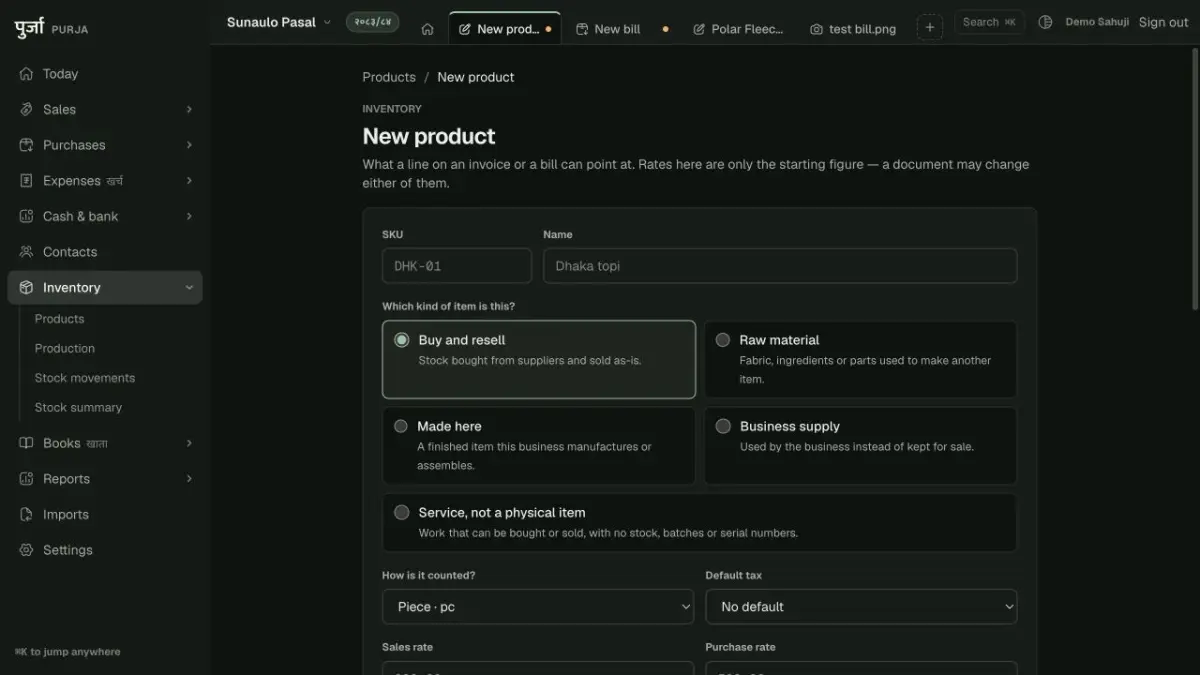
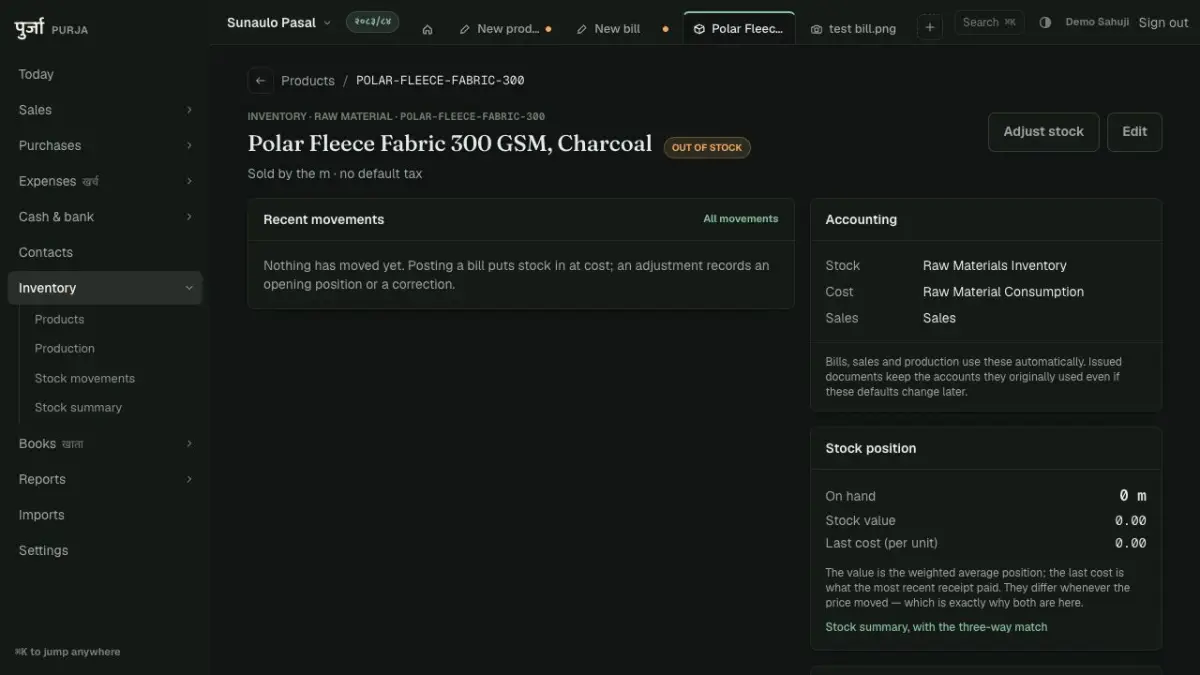
Purja has a shopkeeper's view for the day and an accountant's view for investigation. They are two views of the same ledger.
Every part of it, free
There are no paid tiers and no modules to buy later. This is the whole list.
Make a bill on one screen and print it on A4 or the 80mm roll, or send it as a link. A walk-in sale needs no customer name; the paper says नगद बिक्री.
Who owes you, who you owe, and how long it has been outstanding. Part payments, advances, and one payment settling several bills at once.
Quantity, cost and value per store, not only in total. A sale that would take stock below zero is refused.
How much, and what for. The account it posts to is worked out from that answer.
Sales book, purchase book and the figures for your return. A tax invoice prints COPY from the second printing onward, and a VAT-registered shops can set up CBMS reporting after successful verification.
How am I doing. What I own and owe. Who owes whom. The same figures appear as P&L, balance sheet and trial balance in the accountant's view.
Built for a kirana, a clothing shop, a hardware store, a workshop that bills by the job: anywhere one or two people keep the books themselves, with or without an accountant behind them.
Nepal, not a locale setting
Dates are stored in AD and shown in Bikram Sambat from the real month table, so the fiscal year starts on the correct day. Every dated figure is returned in both calendars.
Invoice numbers are assigned by the server when you issue, gap-free and scoped to the fiscal year. Reprinting an issued tax invoice marks it COPY.
धन्यवाद
The IRD's rules
The Inland Revenue Department sets out how billing software has to behave. Purja was written to those rules from the first line, not fitted to them afterward.
Invoice numbers are assigned by the server at the moment of issue, in order, without gaps, and start again each fiscal year.
An issued bill cannot be edited or removed. A mistake is corrected with a credit note, and the audit trail records who did what, and when.
A tax invoice is issued once. Every printing after the first is marked as a copy.
A VAT-registered shop can set up reporting to the department's Central Billing Monitoring System. Live use depends on that shop's credentials, configuration and successful verification.
Lamp can confirm the current hosting and data-location details for a shop before it goes live.
Sales book, purchase book and the VAT return figures, in the department's format, for any period you choose.
IRD approval certificate not verified. Purja is not represented as IRD-approved until a certificate and listing evidence are available. Ask Lamp for the current status and supporting information for your shop.
Underneath
The rules the ledger keeps. Skip it if it isn't your concern.
Every journal entry goes through the same function. Imports, the app and the API all use that one path.
What a customer owes, what an account holds and what stock is worth are calculated from the entries when you ask. No running totals are stored.
Money is stored as whole paisa, not as decimals. A rounding difference is posted as its own line.
The journal entry, the stock movement and the cost. An invoice with payments against it will not cancel until those are undone, and the message names them.
A self-check re-derives seven of these. The trial balance foots to zero, stock matches across three sources, each bill's payments add up to its settled amount, advances sit on the correct side, and a fully returned sale leaves every account where it started. It reports any that disagree.
Your data
Purja is run by Lamp Solutions Private Limited, registered in Kathmandu.
Lamp can confirm the current hosting and data-location details before your shop goes live.
Every connection between your device and the server uses TLS.
Stored data and backups are encrypted on disk.
A record in one company cannot reference a record in another.
We do not sell your data, show you advertising, or pass your figures to banks or lenders.
Straight answers
Not from access to your books. Purja's billing, accounting and inventory stay free. Lamp charges for Purja AI, the optional assistant that reads what you say, reads a photographed bill and answers questions in words. It is separate from the books, and the books do not need it. Read the full answer.
Purja is built to the IRD's Electronic Billing Procedure: gap-free invoice numbers, no editing or deleting of an issued bill, COPY on every reprint, and the sales and purchase books. An IRD approval certificate has not been verified, so Purja is not represented as IRD-approved. CBMS needs each shop's setup and successful verification before live use. Lamp can confirm current hosting and data-location details for your shop.
From Settings → Purja AI inside your shop: choose a month, a quarter or a year, pay by eSewa or bank transfer, and send the payment reference. A person at Lamp checks it against the bank's own statement and switches it on, usually the same day. No card is asked for and nothing is charged in the browser. When a paid period ends, free Purja carries on as normal and every shop still has its 100 free AI readings, 20 photographs and 30 voice minutes a month.
Yes: the screens, both calendars, and the amount in words on the printed bill. English is one switch away, on the same books.
There are two views of the same books. The accountant's view has the journals, the day book, the trial balance and the chart of accounts, and everything exports.
Customers, suppliers, products and opening balances import from a file. Imports use the same validation as manual entry.
No. The shopkeeper's view asks in plain terms and works out the accounting. The accountant's view is one switch away if you want it.
A self-check re-derives the trial balance, the stock and every bill's payments, and reports anything that disagrees. Issued bills are never edited: a correction is a cancellation or a credit note, so the trail stays intact.
Your data exports in full at any time: documents, contacts, stock and the ledger.
A company you can find
Purja is made and run by Lamp Solutions Private Limited in Kathmandu. Ask about setup, your existing bills, or what your tax office needs.
Contact Lamp SolutionsCompanyLamp Solutions Private Limited
OfficeWard No. 6, Ramkot, Nagarjun Municipality, Kathmandu
Registration399278/83/84
PAN623682236
Try it on your own shop
Put a real month through it, including the returns, the part payments and the customer who paid in two instalments. If the figures don't match your own, tell us.
Bills, khata, stock, expenses, VAT, the IRD's books, the CBMS workflow, both print sizes, share links, two views and the year-end close. No tiers, no trial period. Purja AI is the optional paid assistant on top — Rs 1,699 a month, with 100 free AI readings a month for every shop; the books do not depend on it.
No card · nothing expires · your data exports whole, whenever you ask